
Emergency Power Kit Checklist: 5 Disaster Scenarios, 5 Complete Kits
Table of Contents
Affiliate disclosure: Some links on this page are affiliate links. If you buy through them we may earn a commission, at no extra cost to you. This never influences our rankings or verdicts.
One Kit Does Not Fit Every Outage
The emergency power kit you pack for a Gulf Coast hurricane looks nothing like the one you need for a California Public Safety Power Shutoff, and neither resembles the setup required to keep an oxygen concentrator running through a multi-week grid failure. Yet most preparedness checklists treat outages as interchangeable events. They are not.
When Hurricane Helene tore through western North Carolina in September 2024, some Asheville-area residents went three weeks or longer without grid power, cell service, or municipal water. Hurricane Beryl left 2.7 million Texas customers dark in July 2024, many for more than a week in 95-degree heat. Winter Storm Enzo froze the Gulf South in January 2025. Each of these events demanded a different kit, a different solar generator class, and different ancillary gear.
This guide breaks down five realistic disaster scenarios and matches each to one of SolarGenReview's four capacity classes: Small (200-700 Wh), Mid (700-1,500 Wh), Large (1,500-3,600 Wh), and XL expandable (3,600+ Wh). Use it to build toward what your region actually faces, not a generic bug-out fantasy.
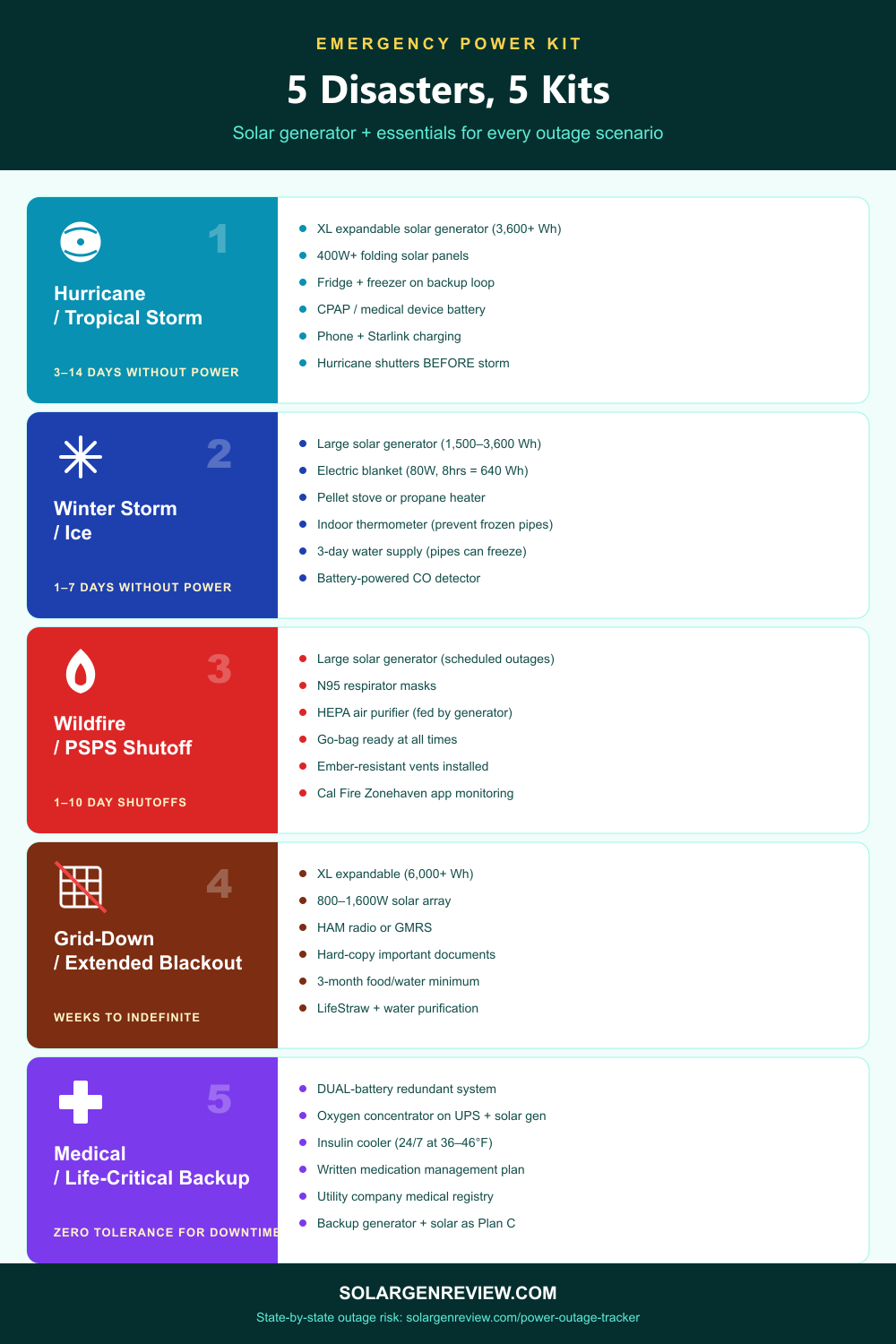
1. Hurricane / Tropical Storm Kit
Expected duration: 3 to 14 days, with outliers stretching to a month. Helene's mountain-county outages ran past day 21 because roads and substations were both destroyed.
Recommended class: XL expandable (3,600+ Wh) paired with at least 400W of portable solar. Hurricanes bring days of cloud cover, so you need reserve capacity plus recharge capability once skies clear.
Essentials and why each one matters
- XL solar generator with two expansion batteries — runs a full-size fridge, phone charging, fans, and LED lights for a week before needing solar input.
- 400W+ solar panel array — once the storm passes, sun returns fast. This is your only recharge path when gas stations are closed or out of fuel.
- 12V DC fridge adapter or inverter fridge — cuts fridge draw roughly in half versus standard AC.
- Tarps, roofing screws, cordless drill — roof patching prevents the follow-up disaster of interior rain damage.
- Chainsaw (battery or gas) with fuel — trees block roads and driveways for days.
- 2 weeks of shelf-stable food per person — grocery logistics collapse in the impact zone.
Critical timing: Buy and commission the system before the storm is named. Supply chains into affected regions collapse for weeks. After Helene, generators shipped to Asheville took 10+ days to arrive.
2. Winter Storm / Ice Event Kit
Expected duration: 1 to 7 days. Winter Storm Enzo knocked out power from Houston to New Orleans for up to five days in January 2025.
Recommended class: Large (1,500-3,600 Wh). You are not running a furnace, you are running targeted warmth and pipe protection.
The math that matters
An 80W electric blanket across an 8-hour night consumes 640 Wh. A Mid-class 1,500 Wh unit therefore covers roughly two full nights of blanket use, and a Large unit covers nearly a week when paired with daytime solar input. That is enough to sleep safely in a house sitting at 45 degrees.
- Indoor-outdoor thermometer — know when interior temps approach 32 degrees and pipes need dripping.
- Electric blankets and heated throws — heat bodies, not rooms.
- Battery-powered CO detector — if you run any fuel heater indoors (do not), this is non-negotiable.
- Heated faucet tape or pipe insulation — cheaper than a burst pipe.
- Insulated thermos + kettle — one 500W kettle boil stores hot drinks for hours without repeat draw.
Cold-weather caveat: Lithium iron phosphate batteries lose 10 to 20 percent usable capacity below freezing. Keep the unit indoors or in an insulated garage. Charging below 32 degrees is harmful to most chemistries — check your model's low-temp cutoff.
3. Wildfire / PSPS Shutoff Kit
Expected duration: 1 to 10 days. Public Safety Power Shutoffs in California, Oregon, and parts of Colorado are now routine fall events. PG&E's 2019 shutoffs hit two million people; 2023 and 2024 events were shorter but still multi-day.
Recommended class: Large (1,500-3,600 Wh), because PSPS events include scheduled recharge windows between outages.
Kit specifics
- HEPA air purifier (plug it into the generator) — wildfire smoke AQI routinely exceeds 300 in affected counties. A 50W purifier running 24 hours draws 1.2 kWh.
- N95 respirators — one per person per day minimum during active smoke.
- Ember-defense kit — metal rake, long hose, gutter cleaned of needles, 1/8-inch mesh over vents.
- Go-bags staged by the door — evacuation orders often come in minutes.
- Cal Fire Zonehaven app (or Watch Duty) — real-time evacuation zone status.
Fire-zone residents should know their evacuation zone number before any smoke appears on the horizon.
4. Grid-Down / Extended Blackout Kit
Expected duration: weeks to indefinite. The 2021 Texas Winter Storm Uri collapse and the 2003 Northeast blackout are the benchmark historical events. A repeat of either would test every household's depth of storage.
Recommended class: XL expandable (6,000+ Wh total battery) with an 800 to 1,600W solar array. This is the one kit where you plan to be fully off-grid for the duration.
- HAM or GMRS radio — cell towers fail within hours of generator fuel exhaustion. GMRS is license-by-family and covers 5 to 25 miles.
- Three months of stored water (minimum) plus a LifeStraw or Sawyer Squeeze for surface-water filtration.
- Hand tools, not power tools — you cannot spare battery for a circular saw when you need it for the freezer.
- Paper cash in $1, $5, and $20 bills — card readers and ATMs are both dead.
- Physical maps of your county and neighboring counties.
- 90 days of medication, shelf-stable food, and pet food.
5. Medical / Life-Critical Backup Kit
Expected duration: zero tolerance for any downtime. If someone in the household uses an oxygen concentrator, dialysis equipment, a ventilator, or refrigerated insulin, the kit is not a comfort item.
Recommended class: dual-battery redundant configuration. Two Large or XL units, both kept at 100 percent, alternated weekly. If one fails, the second takes over instantly.
Load math
A continuous-flow oxygen concentrator at 350W running 24 hours consumes 8.4 kWh per day. That alone justifies XL capacity plus daily solar recharge of 1,000W or more. A pulse-dose concentrator uses far less — closer to 100W average — but the math should use the highest-demand mode the patient actually requires.
- Insulin cooler maintaining 36 to 46 degrees continuously (4oz Frio or 12V medical cooler).
- CPAP with DC cable — skip the humidifier during outages to cut draw from 60W to about 10W.
- Utility medical-priority registration — California (Medical Baseline), New York (LifeSupport), and Texas (Critical Care) all flag the address for faster restoration.
- Backup of the backup — a small portable unit that can run the device for 8 hours if both primary units fail.
Shared Essentials Every Kit Needs
Regardless of scenario, every household kit should contain:
- One gallon of water per person per day, 3-day minimum (FEMA standard; 14 days preferred).
- First-aid kit with a rotating 30-day prescription supply.
- Battery or hand-crank NOAA weather radio.
- Physical flashlights and headlamps with spare batteries in a separate container.
- Paper cash in small denominations.
- Laminated or waterproof copies of insurance documents, IDs, medication lists, and emergency contacts.
- Manual can opener — the most forgotten item on every list.
How to Build Your Kit Without Spending $5,000 at Once
The single biggest mistake is buying the wrong class first. Start with the capacity tier that matches your state's actual outage risk — hurricane-belt households need XL; Pacific Northwest PSPS households can start Large; Midwest tornado country can usually start Mid and expand.
Check our power outage tracker for live and historical outage data by state before committing to a class.
Rough budget by class
- Small kit (200-700 Wh): around $500, covers phones, lights, and a CPAP for one night.
- Mid kit (700-1,500 Wh): around $1,200, adds a fridge for 12 hours and a fan for 24.
- Large kit (1,500-3,600 Wh): around $3,000, runs a fridge for 2 days or heating essentials for a week.
- XL kit (3,600 Wh+, expandable): $6,000 and up, handles multi-week hurricane or grid-down scenarios.
Buy the main unit first. Add solar panels second — they are useless without the storage to feed. Expansion batteries and extra panels can be purchased over the following 12 months on any platform that supports stacking. A two-year build plan costs the same as a one-year build and leaves cash for water, food, and medications in the meantime.
Preparedness is not about the worst day imaginable. It is about the second Tuesday in October when a transformer blows and the power is out for 36 hours, and the kit you assembled last spring turns a crisis into an inconvenience.
Frequently Asked Questions
How big of a solar generator do I need for home backup?
For essential home backup (fridge, lights, phones, internet), a Large-class 1,500-3,600 Wh unit handles 1-2 days comfortably. For multi-week hurricane or grid-down scenarios, step up to an XL expandable system with 6,000+ Wh of battery and 800W or more of solar. Match the class to your region's realistic outage duration, not the worst case you can imagine.
What should be in a hurricane power kit?
An XL expandable solar generator (3,600+ Wh) with 400W of solar panels, two weeks of shelf-stable food and water per person, tarps and roofing screws, a chainsaw with fuel, a battery-powered fan, and a NOAA weather radio. Buy and install the generator before the storm is named — supply chains into impact zones collapse for weeks, as seen in western North Carolina after Hurricane Helene in 2024.
How long does a solar generator last during a power outage?
It depends on load and capacity. A 1,500 Wh Large unit runs a full-size fridge for about 24 hours, a CPAP for 4-5 nights, or LED lights and phone charging for a week. With daytime solar recharge of 200W or more, runtime extends indefinitely as long as the sun cooperates. Cloudy hurricane aftermath reduces solar output by 60-80 percent, so oversize your battery accordingly.
Can a solar generator run a CPAP all night?
Yes, easily. A CPAP without a humidifier draws about 10W, using roughly 80 Wh over an 8-hour night. Even a Small 300 Wh unit covers 3 nights on a single charge. Skip the heated humidifier during outages — it can push draw to 60W and cut runtime by 80 percent. Most CPAPs also accept a DC cable, which is more efficient than running through an AC inverter.
Do solar generators work when it's cloudy?
Yes, but at reduced output. Expect 10-25 percent of rated panel wattage on heavily overcast days, 40-60 percent on bright-cloudy days. A 400W panel array might produce only 60-100W in hurricane aftermath conditions. This is why battery capacity matters more than panel wattage for disaster use — you need reserves to carry you through the 2-3 cloudy days before sun returns.
How much water should I store for an emergency?
FEMA's minimum is one gallon per person per day for 3 days, but that is the floor, not the target. For hurricane or grid-down scenarios, store 14 days per person (14 gallons each). For extended grid-down planning, aim for 90 days of storage plus a filter like a LifeStraw or Sawyer Squeeze for surface-water backup. Do not forget pets — a medium dog needs about half a gallon per day.
What's the difference between a solar generator and a regular generator?
A solar generator is a lithium battery with an inverter and solar charge controller — silent, emissions-free, safe to run indoors, and rechargeable from sunlight. A regular (gas or propane) generator is a combustion engine that produces AC power directly — louder, requires ventilation, needs stored fuel that goes stale, and cannot run indoors without risking carbon monoxide poisoning. For multi-week outages where fuel delivery collapses, solar wins on resilience. For very large loads like central AC, fuel generators still outperform on raw wattage.


