
Solar Generator Runtime Cheat Sheet
Table of Contents
Affiliate disclosure: Some links on this page are affiliate links. If you buy through them we may earn a commission, at no extra cost to you. This never influences our rankings or verdicts.
Why Runtime Is the Only Spec That Actually Matters
After testing solar generators for years, I can tell you the single most-asked pre-purchase question is never about weight, ports, or even price. It's runtime. How long will this thing actually keep my fridge cold, my CPAP running, or my laptop alive when the grid goes down? The marketing sheet says 1024 Wh, but the real-world answer is always less — sometimes a lot less.
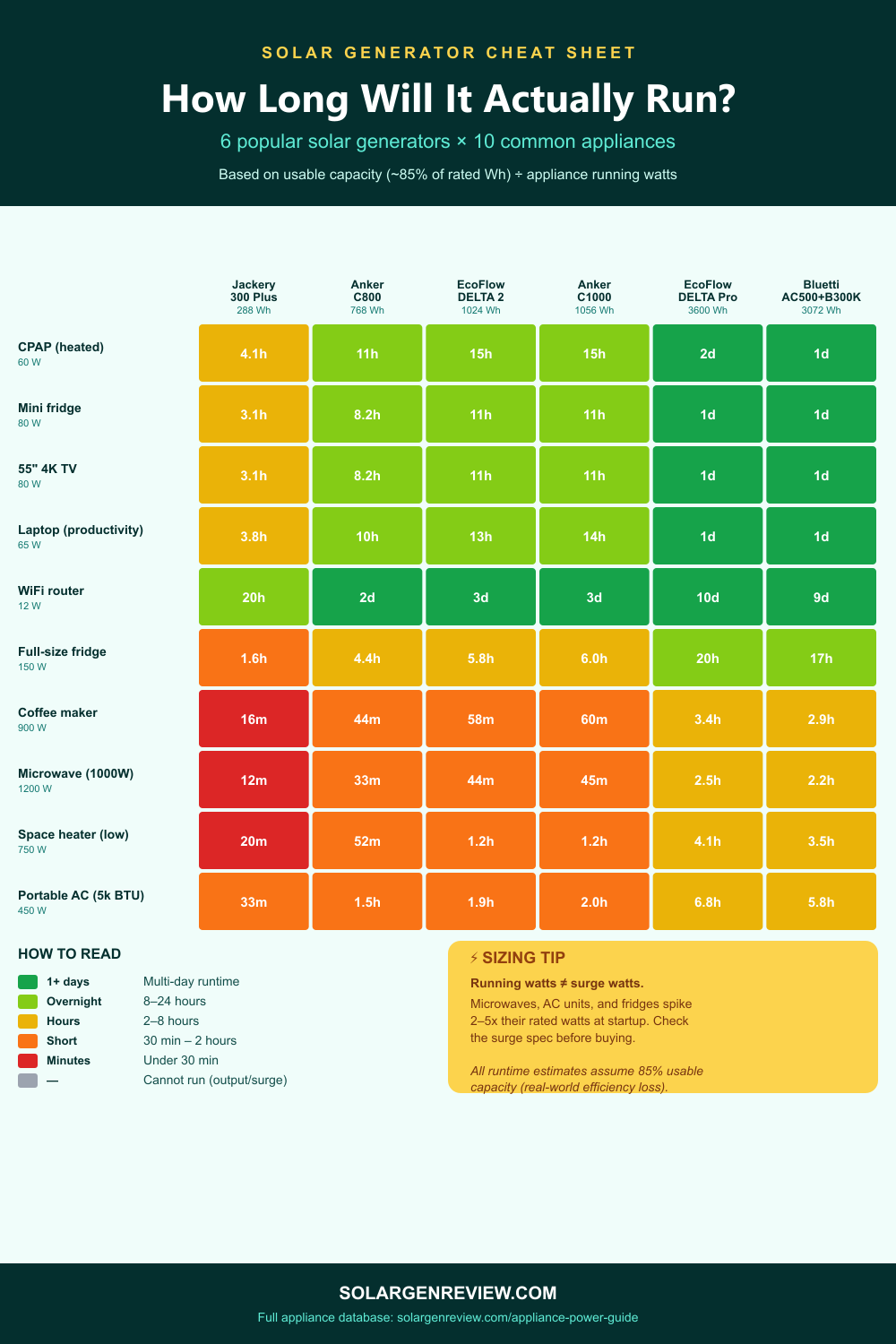
The gap between rated capacity and usable runtime comes down to two things: lithium batteries aren't designed to be drained to zero, and inverters lose energy converting DC to AC. I apply an 85% rule to every unit I test, which matches what I actually measure on the bench. This cheat sheet takes six of the most popular units on the market right now and runs the numbers against ten common appliances.
How Runtime Is Actually Calculated
The formula I use is simple and it tracks real-world results within about 5%:
(Rated Wh x 0.85) / Running Watts = Hours of Runtime
So why 85%? Two reasons. First, LiFePO4 chemistry — which every modern unit in this guide uses — has a recommended depth-of-discharge of roughly 90% to preserve cycle life. Most units will cut off before you hit 100% drain anyway. Second, inverter efficiency sits between 85% and 92% depending on load. Low loads are actually less efficient because the inverter's own overhead eats a larger percentage. The 0.85 multiplier bakes both losses into one number.
Surge wattage is a separate conversation. Every AC motor — fridges, pumps, power tools — draws 2 to 6 times its running wattage for the first fraction of a second. If that surge exceeds your inverter's surge rating, the appliance will not start, even if the running watts fit comfortably. Check both numbers before buying.
Small Class: Jackery 300 Plus (288 Wh) and Anker C800 (768 Wh)
These are what I call "overnight" units. You're not running a fridge through a blackout, but you are keeping a CPAP going, charging phones, and running laptops at a campsite or during a short outage.
The Jackery 300 Plus has 288 Wh rated, or about 245 Wh usable. A modern CPAP without humidifier pulls around 30W, giving you roughly 8 hours — one full night. With humidifier, that drops to 40W and about 6 hours. A 60W laptop runs about 4 hours. Phones charge 20-plus times before the unit dies.
The Anker C800 steps up to 768 Wh, or 653 Wh usable. That's 21 hours of CPAP runtime, 10 hours of laptop use, or about 12 hours of a 55W mini-fridge. Check price on Amazon. Both units handle phones, routers, LED lights, and small electronics without breaking a sweat.
Mid Class: EcoFlow DELTA 2 (1024 Wh) and Anker C1000 (1056 Wh)
Cross the 1 kWh line and you can seriously talk about appliance backup. The EcoFlow DELTA 2 delivers 1024 Wh rated, or roughly 870 Wh usable. A 150W average-draw fridge (which cycles, so effective draw is maybe 50W) runs about 17 hours. A 1000W microwave on for 3 minutes pulls 50 Wh, so you get 17 microwave sessions or about 0.87 hours of continuous cook time. A coffee maker pulling 800W for 8 minutes gives you 8-plus pots.
The Anker C1000 is nearly identical in capacity at 1056 Wh (898 Wh usable) but has a 1800W inverter versus the DELTA 2's 1800W as well. Both will start most residential fridges. Routers, modems, and mesh WiFi setups pull 10 to 20W total — these mid-class units keep your internet up for three days.
Large Class: EcoFlow DELTA Pro (3,600 Wh) and Bluetti AC500+B300K (3,072 Wh)
Now we're in home-backup territory. The EcoFlow DELTA Pro packs 3,600 Wh rated, or about 3,060 Wh usable. A cycling fridge at an effective 50W draw runs 61 hours — over two and a half days. A 450W portable AC pulls (3600 x 0.85) / 450 = about 6.8 hours. A 900W space heater on medium runs 3.4 hours.
The Bluetti AC500 paired with one B300K gives you 3,072 Wh, or 2,611 Wh usable. Fridge runtime lands around 52 hours. The AC500's 5000W inverter can handle well pumps, welders, and full kitchen appliances — something the smaller units simply cannot. Both these platforms accept expansion batteries, which I'll cover below.
Appliances That Drain Everything Fast
Some loads will burn through any portable in under two hours. Know the enemy:
- Space heater on high (1500W): Eats 2.5 kWh in 90 minutes. Even a DELTA Pro gives you just over 2 hours.
- Induction cooktop: 1800W continuous. Forty minutes drains a 1 kWh unit.
- Electric kettle: 1500W for 3 minutes per boil — 75 Wh each time adds up.
- Hair dryer: 1800W. Ten minutes equals 300 Wh gone.
- Window AC unit (8000 BTU): 700W continuous, cycles, but still demands serious capacity.
Appliances That Sip Power
The good news: most of what keeps us comfortable during an outage barely registers on the battery gauge. CPAPs average 30 to 50W. Routers and modems pull 10 to 20W. LED light bulbs run 6 to 10W each. Laptops top out around 65W and idle at 20W. Phones take 5 to 20W for a brief charging window. A full evening of lights, internet, and a charging laptop costs under 200 Wh — every unit in this guide can handle that easily.
Real-World Caveats
My formula assumes lab conditions. Real life isn't lab conditions.
- Cold weather: Lithium capacity drops 10% to 20% below freezing. Some units refuse to discharge below 14F. Bluetti and EcoFlow both have heated battery options on newer models.
- Starting surge: Your inverter needs to handle the surge, not just the running watts. Fridges routinely surge to 1200W on startup.
- Pass-through charging: Some units reduce AC output when plugged into solar or shore power. Read the manual.
- LCD and BMS overhead: The display, cooling fans, and battery management system draw 3 to 8W continuously. Leave a unit unused for a week and it can self-discharge 10 to 15%.
How to Extend Runtime
A few techniques consistently double effective runtime in my testing:
- Cycle the fridge: Let it cool to 33F, then unplug for two hours. A well-sealed modern fridge rises less than 4F in that window.
- LED-only lighting: A 60W incandescent replaced by a 9W LED saves 51 Wh per hour.
- Run batteries down by daytime: Use the grid-equivalent appliances during solar recharge hours, saving battery for night.
- Add more solar input: Every watt-hour put back during the day is a watt-hour you don't pull from the battery at night.
- Expansion batteries: The DELTA Pro scales to 25 kWh, the Bluetti AC500 to 18 kWh, and the Anker F3800 beyond both. If you're serious about home backup, buy a platform that grows.
For the complete running and surge wattage list I use during testing, see our appliance power guide. It covers over 140 common household devices with measured draws, not manufacturer estimates.
Frequently Asked Questions
How long will a 1000Wh solar generator run a fridge?
Applying the 85% usable rule, a 1000Wh unit delivers about 850 Wh. A modern Energy Star fridge averages 50W when you account for compressor cycling, giving you roughly 17 hours of runtime. Older or larger fridges can cut that to 10 to 12 hours. Cycling the fridge — letting it cool and then unplugging for two-hour stretches — can stretch that past 24 hours.
What can a 300Wh power station run?
A 300Wh unit like the Jackery 300 Plus has about 245 Wh usable. That translates to one full night of CPAP (7 to 8 hours), 4 hours of laptop use, 20-plus phone charges, 15 hours of LED lighting, or around 10 hours of WiFi router uptime. It will not run fridges, microwaves, heaters, or any high-draw appliance for a meaningful time.
How long can a solar generator run a CPAP?
CPAPs draw 30 to 60W depending on model and whether the humidifier is on. On a 288Wh unit expect 6 to 8 hours without humidifier, 4 to 6 with it. A 768Wh Anker C800 runs a CPAP 15 to 21 hours — two to three nights. Turn off humidifier and heated hose to nearly double runtime.
Does cold weather affect solar generator runtime?
Yes, significantly. LiFePO4 batteries lose 10% to 20% of usable capacity below freezing. Below 14F, many units refuse to discharge at all to protect the cells. Newer models from EcoFlow and Bluetti include battery heaters for cold-weather operation. Keep the unit inside a tent, vehicle cab, or insulated box during winter use.
Can I run a space heater on a solar generator?
Technically yes on any unit with a 1500W+ inverter, but it's a terrible idea for extended use. A 1500W heater burns through 2.5 kWh in 90 minutes — an EcoFlow DELTA Pro (3,600 Wh) gives you about 2 hours on high. For heating, use a 200W to 400W radiant panel or a Mr. Buddy propane heater and save battery for essentials.
What solar generator is best for home backup?
For whole-home backup lasting multiple days, the EcoFlow DELTA Pro (3,600 Wh, expandable to 25 kWh) and Bluetti AC500+B300K (3,072 Wh, expandable to 18 kWh) are the current leaders. Both accept multiple expansion batteries and can be hardwired to a transfer switch for circuit-level backup. The DELTA Pro has a slight edge in solar input speed; the AC500 has a more powerful 5000W inverter.
How do I extend solar generator runtime?
Cycle the fridge (cool to 33F, then unplug for 2 hours at a time), replace all lighting with LEDs, add solar panels to replenish the battery during daylight, eliminate phantom loads by unplugging idle electronics, and run high-draw appliances only during solar recharge hours. On compatible platforms, adding an expansion battery is the single biggest runtime multiplier.


