
Watts vs Watt-Hours Explained (2026)
Table of Contents
Affiliate disclosure: Some links on this page are affiliate links. If you buy through them we may earn a commission, at no extra cost to you. This never influences our rankings or verdicts.
The one spec mix-up that costs buyers hundreds of dollars
After bench-testing dozens of portable power stations, the same pattern keeps appearing in reader emails. A buyer grabs a unit rated at 1,500 watts, assumes it will run their fridge overnight, and wakes up to a dead battery and a warm carton of milk. Another buyer pays a premium for a 3,600Wh monster to charge a CPAP, which needs about 400Wh per night. Both mistakes come from the same source: confusing watts with watt-hours.
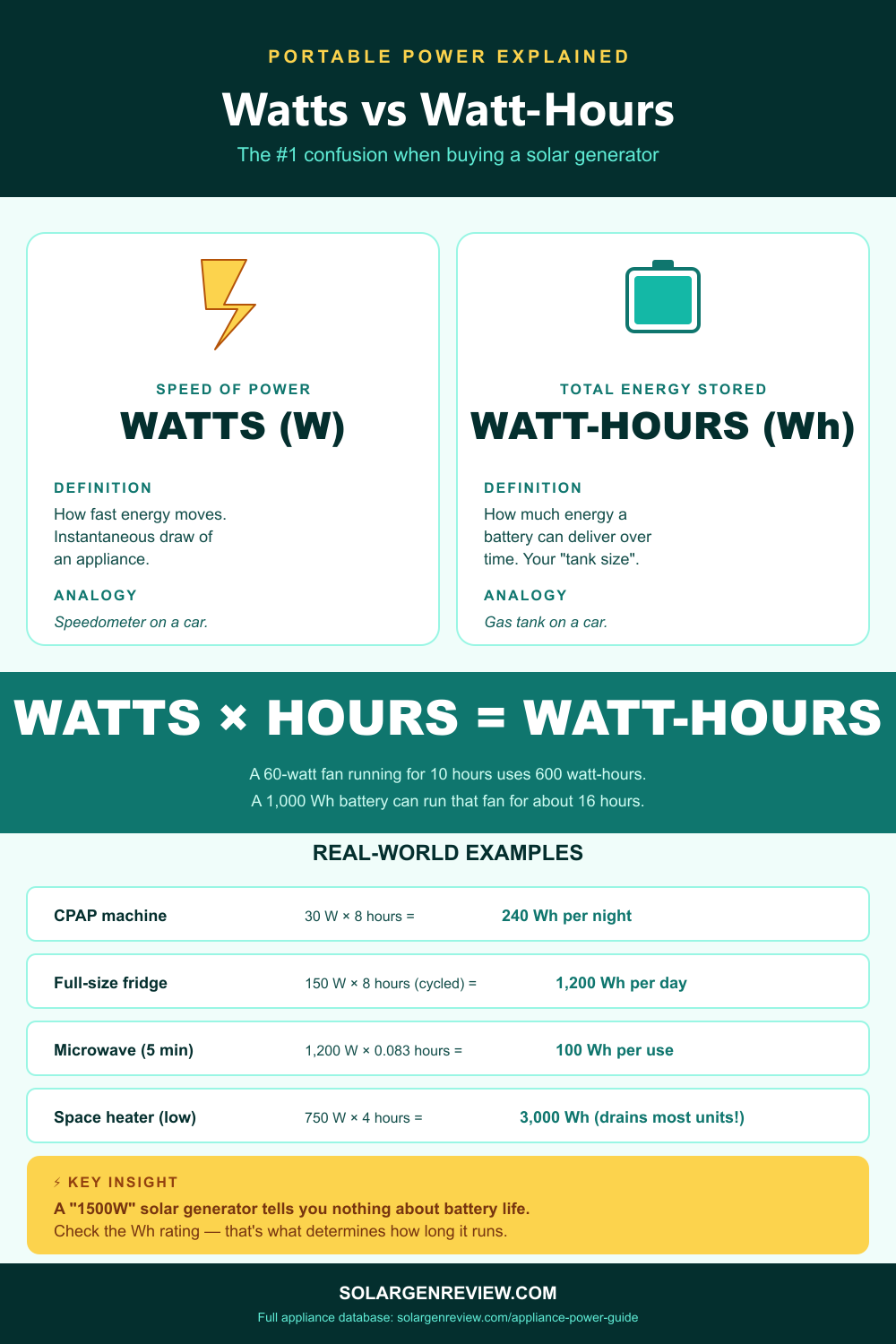
Watts (W) and watt-hours (Wh) measure two completely different things. Watts describe how much power a device pulls at a single instant. Watt-hours describe how much energy is stored or consumed over time. Mixing them up is like confusing the horsepower of your car with the size of its gas tank. Both matter. Neither substitutes for the other.
This guide breaks the concepts apart, shows you the formula that connects them, and walks through a four-step method for sizing a solar generator without guesswork.
Watts: the instantaneous draw
A watt is a unit of power. It tells you how hard an electrical device is pulling at any given moment. Think of it as the speedometer reading on your car: useful right now, but it says nothing about how far you can drive.
Every appliance has a running wattage (what it pulls during normal operation) and many also have a surge wattage (a brief spike when a motor or compressor kicks on). Surge events typically last a fraction of a second but can be two to three times the running draw.
Running wattage examples
- CPAP machine: 30–60W
- LED light bulb: 8–12W
- Laptop: 45–90W
- Wi-Fi router: 6–15W
- Full-size refrigerator: 150W while the compressor is running
- Microwave: 1,200W running, around 1,500W surge
- 1,500W space heater: 1,500W continuous
- Window AC (8,000 BTU): 700W running, 1,800W surge
Your solar generator's continuous AC output rating must exceed the sum of the running watts you plan to use at once. Its surge rating must exceed the largest single surge event. A 1,000W unit cannot start a 1,800W compressor no matter how full the battery is.
Watt-hours: the energy tank
A watt-hour is a unit of energy. One watt-hour equals one watt of power used for one hour. It is the gas tank equivalent: total stored energy available before the battery is empty.
Here is where marketing gets slippery. A unit advertised as 1,000Wh does not actually deliver 1,000 usable watt-hours. Two taxes eat into that number:
- Depth of discharge (DoD): Quality LiFePO4 batteries allow roughly 95% DoD, but manufacturers typically publish usable capacity at around 85% to preserve cycle life and protect the battery management system.
- Inverter efficiency: Converting DC battery power to AC costs another 8–12% as heat.
Stack the two taxes and a 1,000Wh battery realistically delivers about 750–800Wh of AC output before shutoff. DC output through the car port or USB skips the inverter penalty, so you keep more of the rated capacity.
The formula that ties them together
The math is simple: watts multiplied by hours equals watt-hours. Rearranged, watt-hours divided by watts equals runtime in hours.
Worked examples
- CPAP at 40W for 8 hours = 320Wh per night. A 500Wh station covers one night after inverter losses.
- Refrigerator at 150W runs on a duty cycle of roughly 33%, averaging 50W over 24 hours. That is 1,200Wh per day. A 1,500Wh station gets you through one day; a 3,000Wh unit covers two.
- Microwave at 1,200W for 5 minutes = 100Wh. Running the microwave is cheap on energy but demanding on peak output.
- 1,500W space heater for 4 hours = 6,000Wh. This is why heating off-grid with resistive loads is brutal. You need a 6kWh+ expandable unit and serious solar input to sustain it.
Notice how the microwave and the space heater pull the same peak wattage but consume vastly different energy. That is the entire point of keeping the two specs separate in your head.
Why marketing numbers mislead buyers
Manufacturers know that bigger numbers sell. The spec sheet is where that instinct meets technical reality.
"1,500W" could mean two different things
Some listings use "1,500W" to describe the AC inverter output (the running wattage the unit can deliver). Others use it loosely in marketing copy to imply battery capacity. They are not the same. Always confirm which spec is which by looking for the units: W for power output, Wh for energy storage.
Peak vs continuous
A unit might advertise "3,000W peak" in bold and list "1,500W continuous" in smaller text. The peak figure is surge handling, good for a few seconds. The continuous figure is what runs your appliances all night.
DC versus AC output watts
Total output watts sometimes sum DC ports and AC ports together. You cannot pull all of that through the AC inverter. Check the AC inverter rating specifically.
Amp-hours vs watt-hours
Older RV and marine gear advertises capacity in amp-hours (Ah). To convert, multiply by the battery voltage: Ah times volts equals Wh. A 100Ah 12V battery stores 1,200Wh of raw energy. A 100Ah 24V battery stores 2,400Wh. Never compare Ah numbers across different voltages.
How to size a solar generator in 4 steps
This is the method I use when a reader sends me their load list.
- Step 1 — List every device and its running watts. Use the nameplate on the appliance or a Kill-A-Watt meter for accuracy. Our appliance power guide has typical values for 80+ common loads.
- Step 2 — Sum the running watts of devices used simultaneously. That total is the minimum continuous AC output your unit must deliver. Add a 20% buffer.
- Step 3 — Identify the highest surge draw. Usually this is a compressor (fridge, AC, well pump). Your solar generator's surge rating must exceed this number with margin.
- Step 4 — Sum daily watt-hours and multiply by days of autonomy. Divide by 0.85 to account for usable capacity and inverter losses. That is your minimum battery size in Wh.
Common mistakes
- Buying by watts alone. A 2,000W unit with a 500Wh battery runs a microwave for 15 minutes and quits. The output rating tells you nothing about runtime.
- Ignoring the 85% usable rule. LiFePO4 cells last longer when not cycled to zero. The BMS usually cuts off before 100% depth of discharge. Plan for 85% and you will not be surprised.
- Forgetting inverter efficiency. Budget around 90% when running AC loads. A 1,000Wh battery delivers roughly 900Wh to your outlets.
- Overlooking surge on motor loads. Refrigerators, well pumps, and air conditioners can spike to 3x their running draw. A unit that handles continuous load but lacks surge headroom will trip its inverter.
Quick reference: what each Wh tier covers
- 200–700 Wh: Phones, tablets, CPAP for one night, a laptop work session, LED lights and a fan. Camping and short emergencies.
- 700–1,500 Wh: A fridge for most of a day, router and laptop, modest cooking with an induction burner, CPAP for several nights. Weekend off-grid or single-day outages.
- 1,500–3,600 Wh: Heavy appliances in rotation, fridge plus electronics for 24–48 hours, short bursts of microwave or coffee maker. Short-term home essentials backup.
- 3,600+ Wh (expandable): Multi-day home backup, well pump starts, running a chest freezer plus fridge plus essentials. This is whole-home territory when paired with 1,000W+ of solar input.
Once you stop asking "how many watts does this generator have" and start asking "how many watts continuous, how many watts surge, how many usable watt-hours," the buying decision becomes a math problem instead of a marketing pitch.
Frequently Asked Questions
What is the difference between watts and watt-hours?
Watts measure power — the instantaneous rate at which a device pulls electricity. Watt-hours measure energy — how much total electricity is stored or consumed over time. One watt used for one hour equals one watt-hour.
How do you convert watts to watt-hours?
Multiply the device's wattage by the number of hours it runs. A 60W CPAP running for 8 hours consumes 480Wh. To go the other way, divide watt-hours by watts to get runtime in hours.
Is a higher watt-hour rating always better?
Not necessarily. A higher Wh rating means longer runtime, but it also means more weight, higher cost, and longer recharge times. Size the battery to your actual daily load plus a safety buffer rather than buying the biggest number on the shelf.
Why do solar generators have two wattage numbers?
The two figures are continuous output and surge (peak) output. Continuous watts is what the inverter can deliver all day long. Surge watts is a brief spike the unit can handle for a second or two when a motor or compressor starts up.
What does "1500Wh" mean on a solar generator?
1500Wh is the battery's rated energy capacity. After depth-of-discharge limits and inverter losses, expect roughly 1,200–1,275Wh of usable AC output. That is enough to run a 150W fridge for about 8–10 hours of compressor time.
How many watt-hours does a fridge use per day?
A full-size refrigerator averages 1,000–1,500Wh per 24 hours. The compressor runs on a duty cycle of roughly 30–40%, so although it draws 150W when active, the daily total lands far below 150W × 24 hours.
How many watts do I need for home backup?
Sum the running wattage of everything you want powered at once, then add a 20% buffer. Most households need 1,500–3,000W of continuous output plus 3,000W+ of surge capacity to handle a fridge, lights, Wi-Fi, and a microwave simultaneously.


